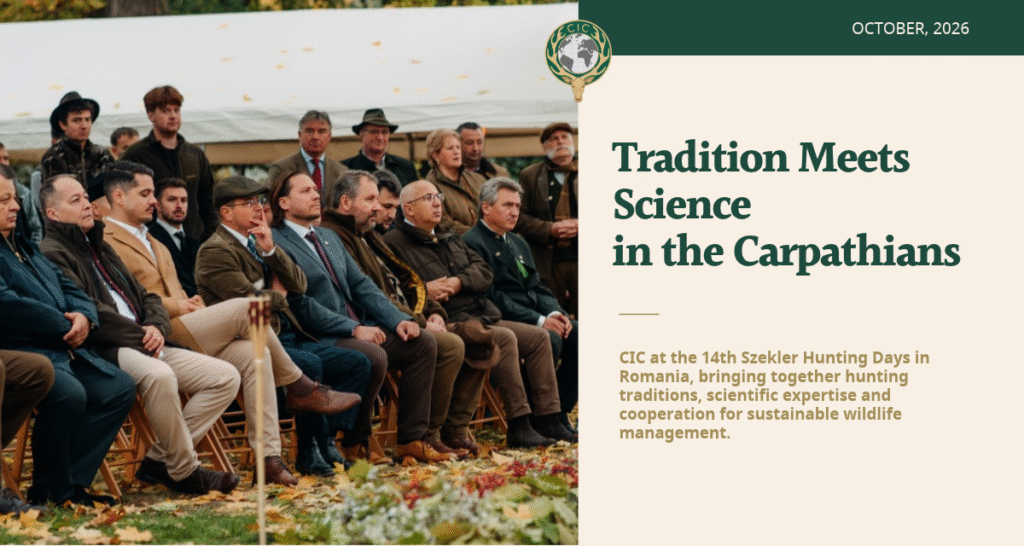
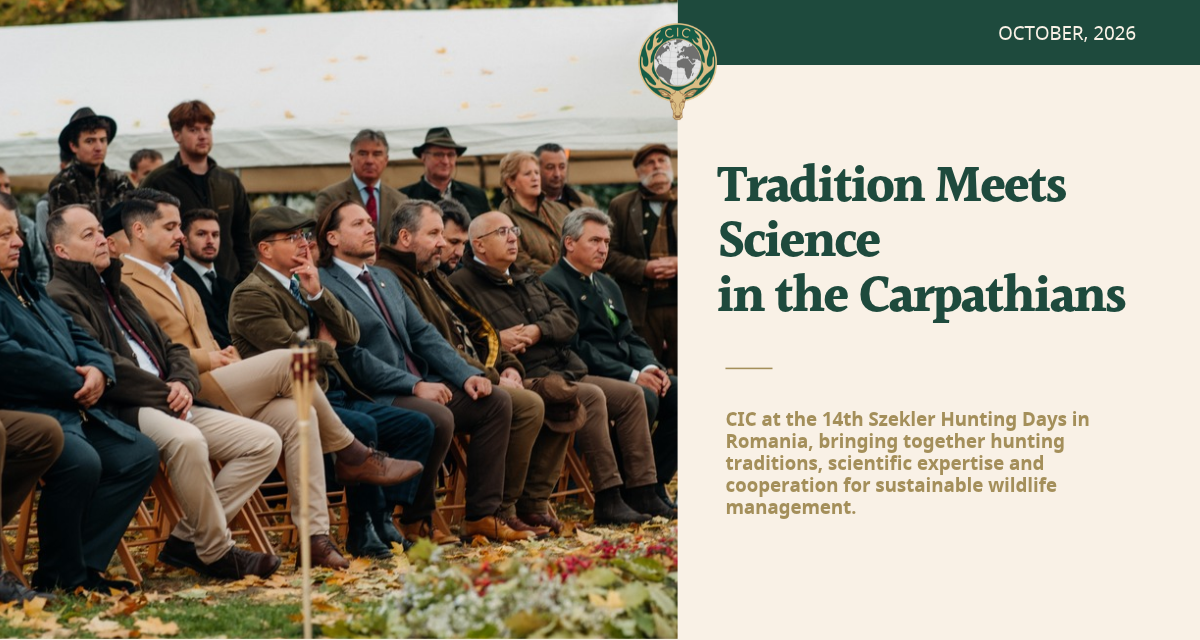
Fiatfalva, Romania, 17 October 2026. The International Council for Game and Wildlife Conservation (CIC) joined Romanian hunting leaders, scientists and policymakers at the 14th Szekler Hunting Days to exchange perspectives on the future of wildlife management and conservation in Romania.
Held at the historic Ugron Castle, the event combined hunting traditions with contemporary conservation challenges. An extensive display of hunting trophies welcomed visitors, while a game cooking competition and cultural festivities celebrated the region’s hunting heritage. The afternoon programme shifted the focus towards science, policy and the practical challenges of sustainable wildlife management.
Hosted this year by Harghita County Council, the event rotates between the three Szekler counties of Harghita, Covasna and Mureș. Among the distinguished guests were the presidents of all three county councils, Barna-Botond Bíró, Sándor Tamás and Ferenc Péter, alongside Romania’s Deputy Prime Minister, Barna Tánczos.
During the Venator Terrae Siculorum (Szekler Hunting Orders of Merit) ceremony, CIC Vice-President Dr. Árpád Sárkány presented an award to Dr. Attila Farkas, recognising his contribution to hunting and wildlife management.
Addressing Romania’s Wildlife Management Challenges
The afternoon scientific conference was organised by Dr. József-Tamás Fodor, a wildlife management specialist and former adviser to Romania’s Ministry of Environment. A strong advocate for modernising the country’s wildlife management system, Dr. Fodor brought together experts to explore how traditional hunting practices, scientific evidence and institutional reform can contribute to more effective management.
CIC Programme Coordinator Thomas Paulic addressed several pressing challenges facing wildlife management in Romania, drawing on practical examples from across the CIC’s international network. His presentation explored brown bear and large carnivore management, reliable wildlife population monitoring, the integration of hunters into broader biodiversity conservation, and the importance of stable, evidence-based management frameworks. It also highlighted the potential of sustainable game meat use and stronger institutional cooperation to benefit wildlife and rural communities. Throughout, the emphasis was on adapting international experience to Romania’s ecological conditions, institutions and local needs, rather than importing ready-made solutions.
The conference also featured Professor Dr. Ovidiu Ionescu, President of the Romanian General Association of Hunters and Sport Fishermen (AGVPS), who explored management-plan-based approaches and opportunities for modernising Romania’s wildlife management system.
Professor Dr. Miklós Heltai, Director of the Institute for Wildlife Management and Nature Conservation at the Hungarian University of Agriculture and Life Sciences (MATE), addressed the importance of data-driven wildlife management, while Dr. Imrich Šuba, Director of the Slovak Hunting Union and President of the CIC Central and Eastern European Coordination Forum, shared insights into the work of the Slovak Hunting Chamber. Together, their contributions highlighted the value of combining scientific evidence, strong professional institutions and regional cooperation in addressing shared wildlife management challenges.
Beyond the formal programme, discussions between CIC representatives and Romanian colleagues provided an opportunity to strengthen existing relationships and explore possibilities for closer cooperation. The exchanges reflected a shared commitment to the conservation and sustainable management of wildlife across the Carpathians.
The CIC thanks Harghita County Council, the Hubertus Hunting Association and Dr. József-Tamás Fodor for their hospitality and looks forward to continuing this dialogue with its Romanian partners.