23 September 2026
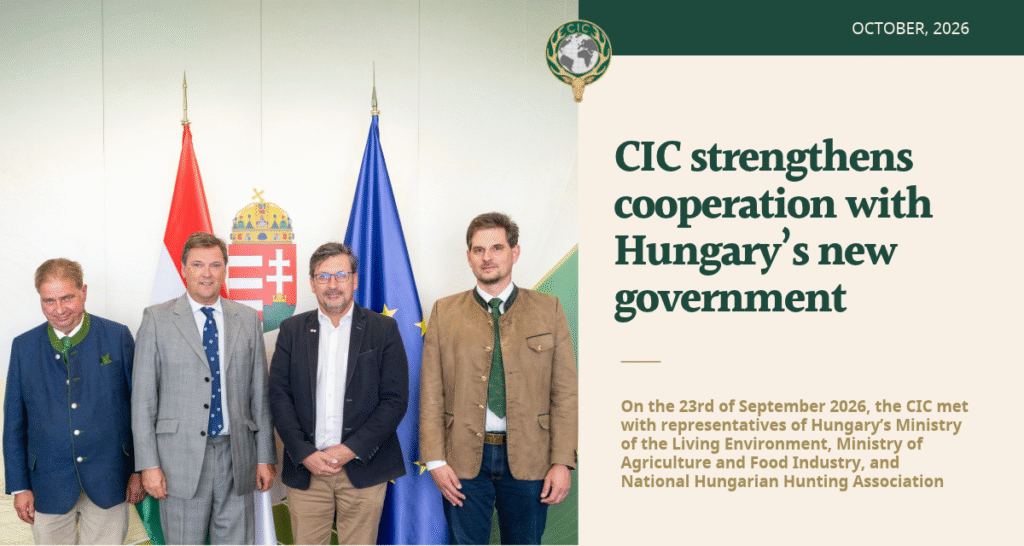
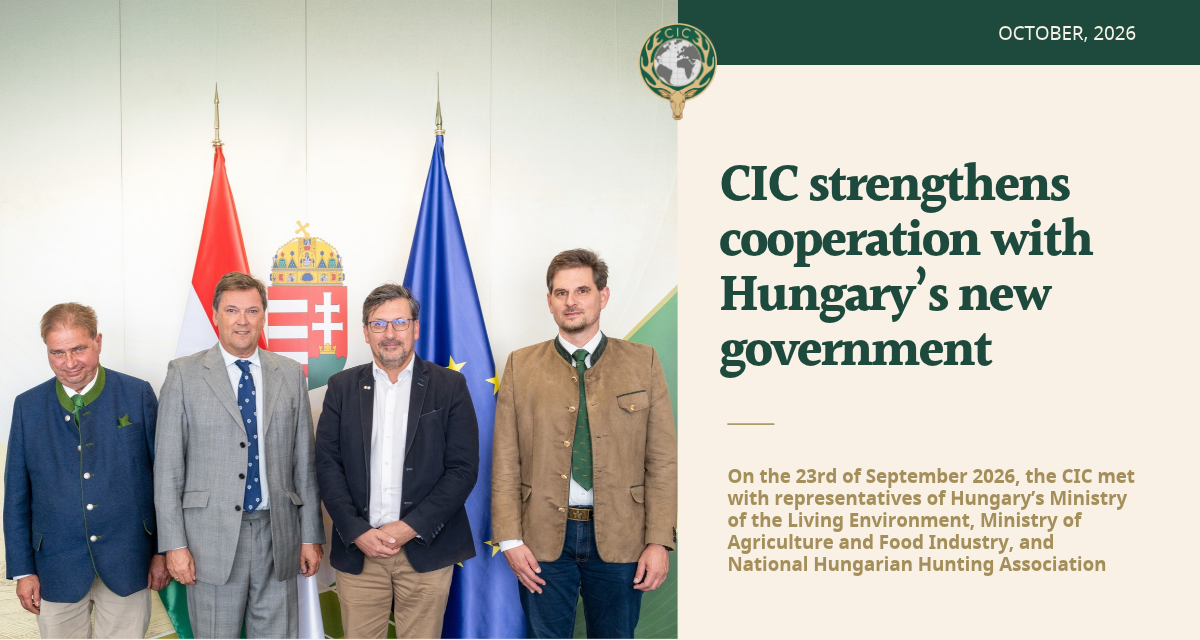
The CIC met with representatives of Hungary’s Ministry of the Living Environment, Ministry of Agriculture and Food Industry, and National Hungarian Hunting Association on the 23rd of September 2026 to establish contact with Hungary’s new government following the April 2026 national elections and discuss future cooperation on wildlife management and nature conservation.
The meetings reaffirmed Hungary’s long-standing partnership with the CIC and confirmed the government’s continued support for the organisation. They also identified opportunities for closer cooperation, particularly in addressing the decline of grey partridge populations in Hungary.
Establishing contact with the new government
Hungary has been a State Member of the CIC and has hosted the organisation’s Administrative Office since 1999. Over the years, Hungary has supported the CIC through the provision of office premises in Budakeszi, diplomatic status and financial contributions linked to the country’s hunting community.
Following the April 2026 elections, responsibilities for forests and nature conservation moved from the former Ministry of Agriculture to the newly established Ministry of the Living Environment. Wildlife management remains the responsibility of the Ministry of Agriculture and Food Industry.
Against this background, the meetings provided an important opportunity for the CIC to establish direct contact with the new government, clarify responsibilities and discuss how the existing partnership could continue to develop.
The CIC delegation included Director General Arno Wimpffen, CIC Ambassador Tamás Marghescu and Science and Governance Coordinator Dr. Kristóf Hecker. Hungarian CIC member Ádám Viplak played an important role in preparing the meetings, particularly in briefing the new State Secretaries’ cabinet at the Ministry of Agriculture.
Hungary reaffirms its support for the CIC
The discussions confirmed Hungary’s continued support for the CIC. The Ministry of Agriculture stated that the organisation’s diplomatic status would remain unchanged and that the Budakeszi office would retain its current status.
The future of the CIC’s city office was not yet settled, but the ministry expressed its willingness to clarify the matter within the government and provide further information.
The meetings also addressed the existing contribution of EUR 1 per hunter. The Ministry of Agriculture explained that the continuation of this support falls within the budgetary remit of the Hunting Chamber. The government would have no objection to its continuation, provided the cooperation remained mutually beneficial.
To reflect the division of responsibilities between the two ministries, the CIC proposed that Hungary’s State Membership representation include representatives from both the Ministry of the Living Environment and the Ministry of Agriculture and Food Industry. Both ministries welcomed this proposal.
The CIC also offered its advisory support to both ministries, building on its long-standing cooperation with the Hungarian State and the National Hungarian Hunting Association. This offer was welcomed and opened the way for further collaboration on shared priorities.
Addressing the decline of grey partridge populations
One of the key opportunities for future cooperation emerged during discussions with the Ministry of the Living Environment, which raised concerns about declining grey partridge populations in Hungary.
The CIC expressed its willingness to take on a coordinating role, bringing together relevant stakeholders to explore practical measures to support the recovery of the species and restore populations to sustainable levels, without requiring it to be classified as a protected species.
Building on the outcomes of the October 2025 Coordination Forum in Hungary and the recent FAO event in Budapest, the CIC highlighted its previous work on the status of small game and reaffirmed its commitment to supporting further action.
Potential cooperation could involve Hungarian universities, the National Hungarian Hunting Association, the Chambers of Hunting and Agriculture, both ministries and other relevant stakeholders.
The discussions also highlighted the potential impact of targeted adjustments to agricultural subsidy regulations. Even relatively small changes could have a significant positive effect on grey partridge populations by improving the conditions needed for their recovery.
This initiative offers an opportunity to connect wildlife management, agricultural practices and conservation expertise through coordinated action.
Strengthening cooperation with the National Hungarian Hunting Association
The CIC also met with the National Hungarian Hunting Association to discuss the partnership between the two organisations and their shared priorities.
The Association recognises the CIC as a strong partner in international hunting diplomacy and requested its assistance in coordinating discussions between the two ministries. The CIC was also asked to work with FACE on commenting on upcoming changes to hunting-related legislation and regulations.
This collaboration could help ensure that relevant expertise and the perspectives of the hunting community contribute to future policy discussions.
Looking ahead
The meetings on the 23rd of September marked an important step in establishing contact with Hungary’s new government and reaffirming the long-standing partnership between Hungary and the CIC.
With the government confirming its continued support for the CIC’s diplomatic status and Budakeszi office, and both ministries welcoming further cooperation, the discussions created a positive foundation for future engagement.
From strengthening coordination between government institutions to exploring practical measures for grey partridge recovery, the CIC looks forward to continuing its work with Hungarian authorities and national hunting organisations to advance wildlife conservation, sustainable hunting and evidence-based wildlife management.