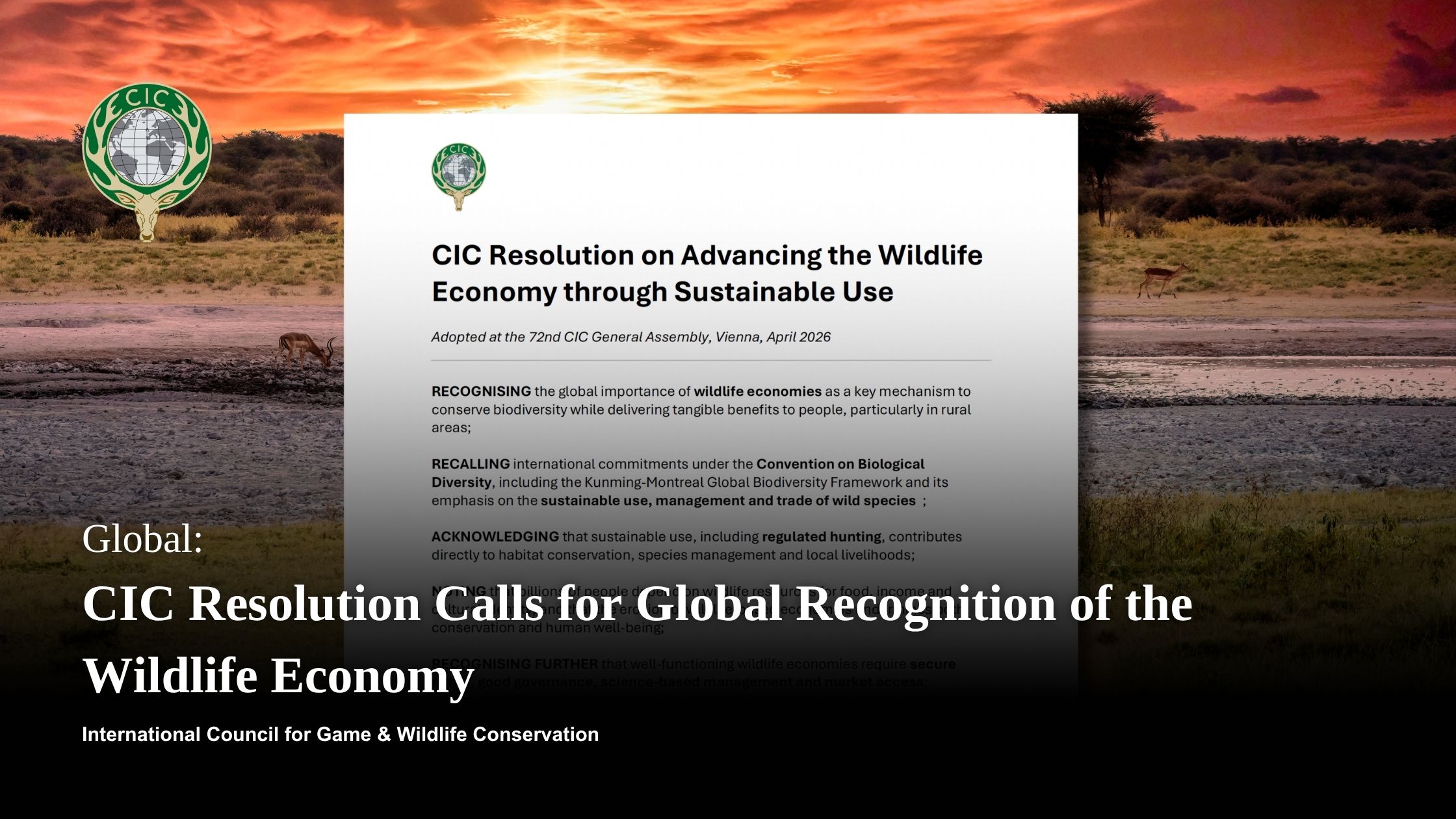
The International Council for Game and Wildlife Conservation (CIC) has formally adopted a resolution on Advancing the Wildlife Economy through Sustainable Use at its 72nd General Assembly in Vienna, Austria — a substantive policy statement calling on governments, international institutions, and conservation partners to recognise and support wildlife-based economies as a cornerstone of effective biodiversity conservation.
The resolution arrives at a moment of growing tension in international conservation policy. Blanket prohibitions on hunting, increasing trade restrictions on wildlife products, and fragmented regulatory frameworks are placing mounting pressure on the incentive structures that underpin conservation in some of the world’s most biodiverse regions. Affirming that sustainable use, including regulated hunting, contributes directly to habitat conservation, species management, and local livelihoods, the resolution makes clear that well-functioning wildlife economies are not a threat to biodiversity — but one of its most reliable and proven protections.
“The wildlife economy is a cornerstone of effective conservation, linking biodiversity, livelihoods and responsible use.” — CIC Resolution on Advancing the Wildlife Economy through Sustainable Use, Vienna 2026
The resolution recognises that billions of people depend on wildlife resources for food, income, and cultural identity, and that the erosion of wildlife-based economies undermines both conservation outcomes and human well-being. It recalls international commitments under the Convention on Biological Diversity and the Kunming-Montreal Global Biodiversity Framework, both of which explicitly recognise sustainable use as a pillar of effective biodiversity policy, and expresses concern that these principles are not consistently reflected in national and international decision-making.
In its operational provisions, the resolution calls upon governments to integrate wildlife-based economies into national conservation and rural development strategies and to ensure science-based, adaptive management of wildlife populations. It urges international institutions and policymakers to avoid non-evidence-based restrictions that undermine conservation outcomes, to affirm regulated hunting as a legitimate conservation tool, and to promote policy coherence across biodiversity, trade, and rural development frameworks.
“Billions of people depend on wildlife resources for food, income and cultural identity. The erosion of wildlife-based economies undermines both conservation and human well-being.” — CIC Resolution on Advancing the Wildlife Economy through Sustainable Use, Vienna 2026
The private sector and conservation partners are encouraged to invest in wildlife-based enterprises delivering measurable conservation outcomes and to support community benefit-sharing mechanisms. The CIC Secretariat, Divisions, and Members are requested to develop a CIC Wildlife Economy Framework and to strengthen the organisation’s advocacy at the CBD, CITES, and IUCN.
Adopted by delegates representing 29 governments, more than 90 NGO partners, and over 1,900 individual members spanning more than 80 countries, the resolution carries the full institutional weight of the CIC membership. Its implications extend well beyond Vienna. In regions where wildlife has tangible economic and social value, conservation works. Where that value is undermined by poorly conceived policy, wildlife and the communities that depend upon it suffer.
“Conservation and use are not opposing concepts, but mutually reinforcing pillars. A strong wildlife economy ensures that wildlife retains its ecological, cultural and economic value, securing its future for generations to come.” — CIC Resolution on Advancing the Wildlife Economy through Sustainable Use, Vienna 2026
Media Contact:
Tristan Breijer MBA FRGS FRSA MCIJ
Director of Communications and Public Affairs
CIC – International Council for Game and Wildlife Conservation
Email: tristan.breijer@cic-wildlife.org
Mobile: +44 781 408 7423
Website: www.cic-wildlife.org