Vienna, 17 April 2026
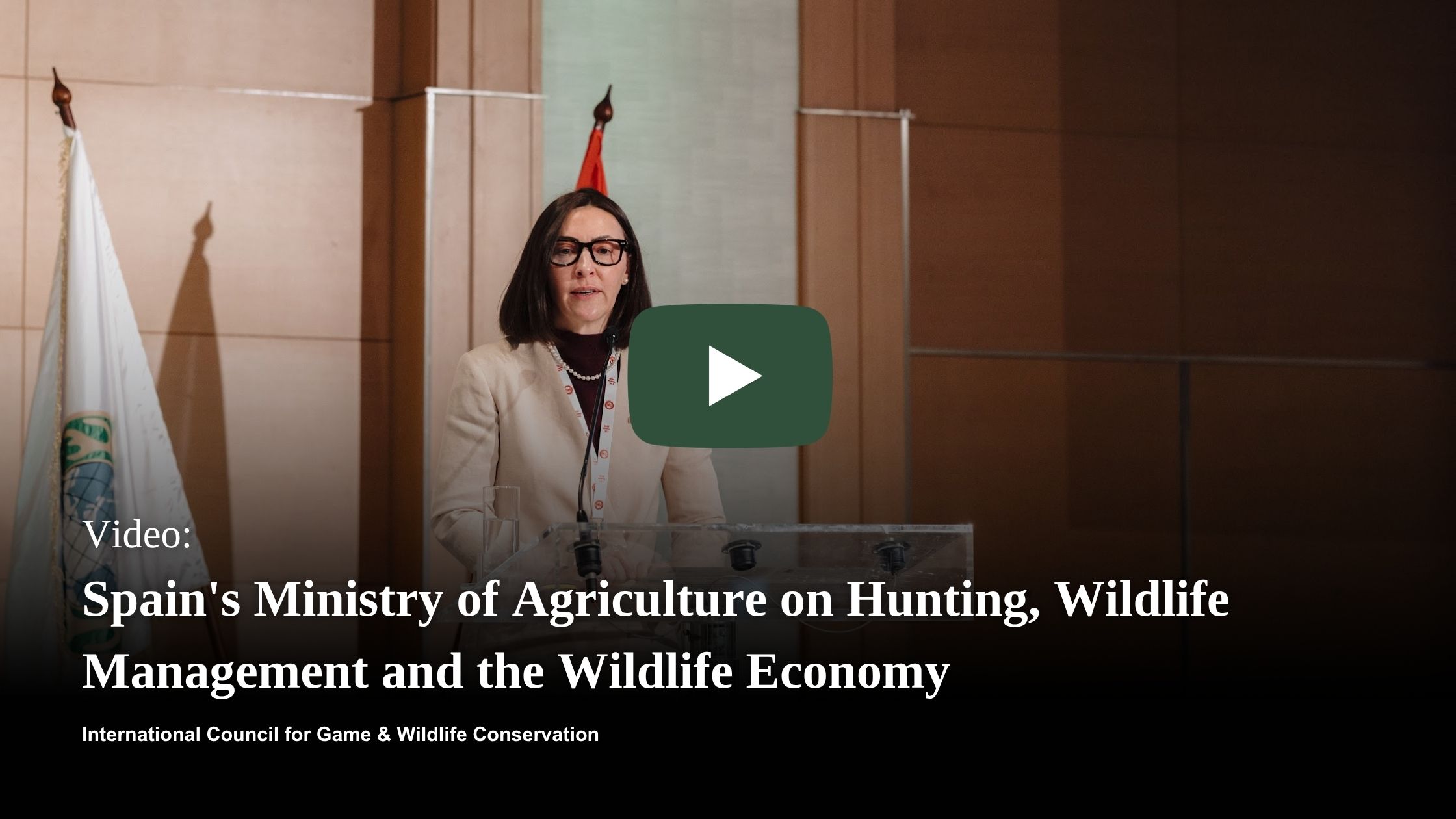
At the 72nd CIC General Assembly in Vienna, Doña Ana Rodríguez Castaño, Secretary General for Agricultural Resources and Food Security at Spain’s Ministry of Agriculture, Fisheries and Food (Ministerio de Agricultura, Pesca y Alimentación), delivered one of the most politically significant ministerial addresses of the entire programme.
Speaking to delegates from 42 countries, Doña Ana made a compelling and data-rich case for the central role of hunting in Spain’s rural economy, biodiversity conservation, and public health. With more than 80% of Spain’s 50.6 million hectares classified as huntable land, she argued that active, science-based wildlife management is not optional — it is essential.
“The wildlife economy is the heartbeat of the Spanish rural world. Sustainable hunting is a modern, technical, and indispensable tool for addressing the complex environmental, demographic, and health challenges of the 21st century.”
She highlighted the scale of hunting’s economic contribution — over 200,000 jobs linked to the sector, representing 0.3% of Spain’s national GDP — whilst warning of the fragility of the model in the face of an ageing hunter population and a lack of generational renewal. Her warning was stark: if hunters were lost as a management tool, the state would be left to manage wildlife alone.
On African Swine Fever, she was direct. Following an outbreak in Catalonia in November 2025, hunting management measures already in place proved critical in containing the spread of the disease — with approximately 400 animals being culled per week to control the outbreak.
“Without hunters, the management would have been very much more complicated. Thanks to the hunting management of wild boar in that region, we got to control the sickness much faster. Hunters here wear a health tool and we use them.”
She also addressed the challenge of wild rabbit — already affecting 56% of insured agricultural land and accounting for 64% of wildlife damage compensation in Spain — and the overabundance of wild boar, which caused 36,000 road accidents in Spain in 2024 alone.
Doña Ana closed with a tribute to the CIC’s legacy and a call for science-based, flexible, and active wildlife management — citing the organisation’s role in founding the IUCN and in the signing of the Ramsar Convention in 1971.
“Tradition and science are the pillars of wildlife economy, where sustainable use guarantees the permanence of our resources. Spain identifies with the values of excellence and responsibility — understanding that management is preservation.”
Media Contact:
Tristan Breijer MBA FRGS FRSA MCIJ
Director of Communications and Public Affairs
CIC – International Council for Game and Wildlife Conservation
Email: tristan.breijer@cic-wildlife.org
Mobile: +44 781 408 7423
Website: www.cic-wildlife.org