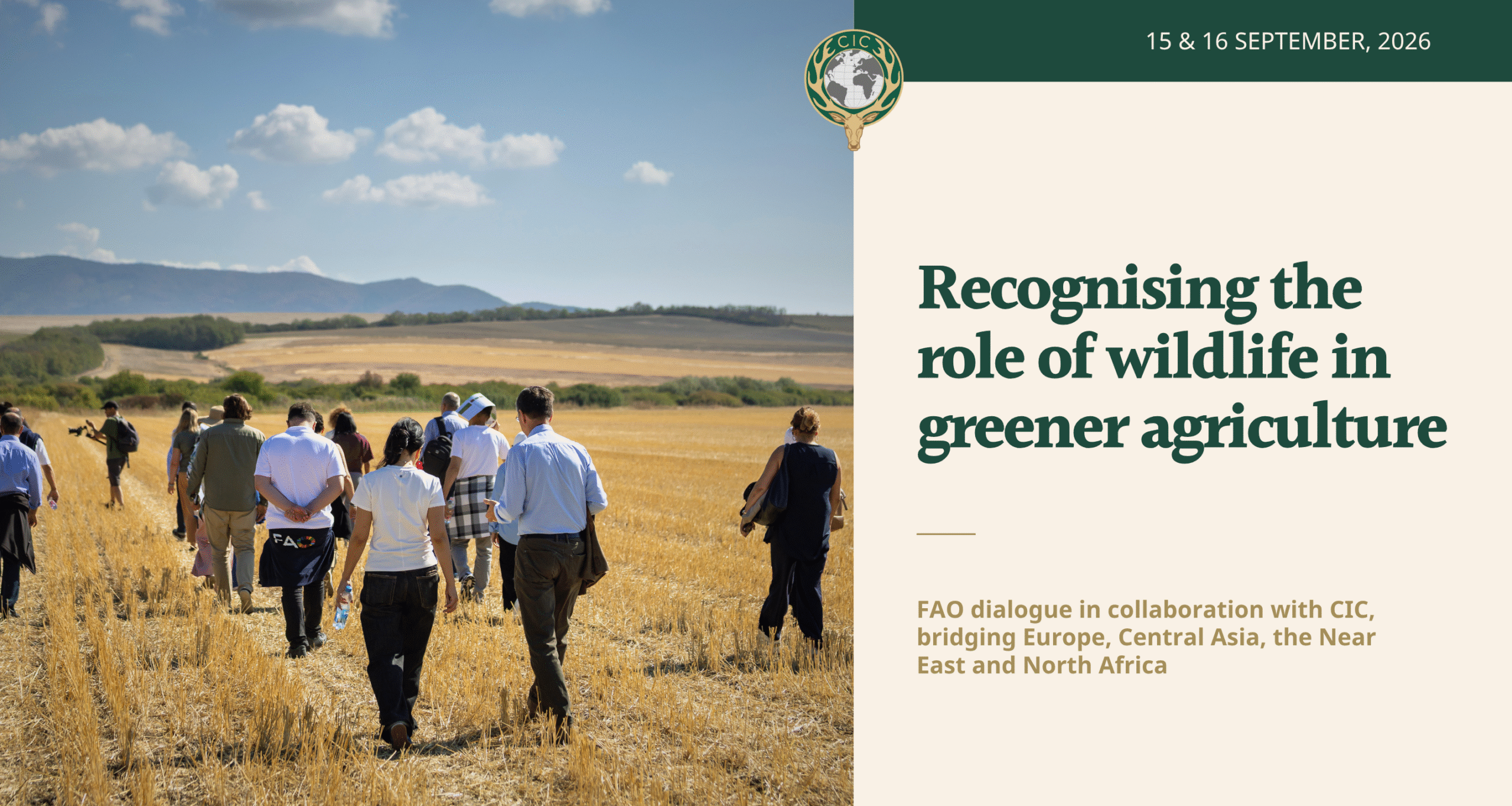
Budapest, Hungary, 15–16 September 2026. The Food and Agriculture Organization of the United Nations (FAO), in collaboration with the International Council for Game and Wildlife Conservation (CIC), brought together agricultural policymakers, technical experts and partners from Europe and Central Asia and the Near East and North Africa for the Interregional Policy Dialogue: Integrated Policy Approach for Greening Agrifood Systems.
Across the two days, discussions examined how countries can move beyond isolated interventions and connect agriculture more effectively with water, biodiversity, climate, finance, markets and rural development. Opening the dialogue in Budapest, Viorel Gutu, FAO Assistant Director-General and Regional Representative for Europe and Central Asia, stressed the strategic importance of green agriculture and the need to turn shared regional challenges into coordinated action. During the discussion on adaptive and integrated governance, CIC Ambassador for Europe Tamás Marghescu added a practical perspective on the realities of bringing together sectors and stakeholders with different responsibilities, interests and motivations, and on creating the conditions needed for meaningful cooperation.
CIC member hosts field study in Kozárd
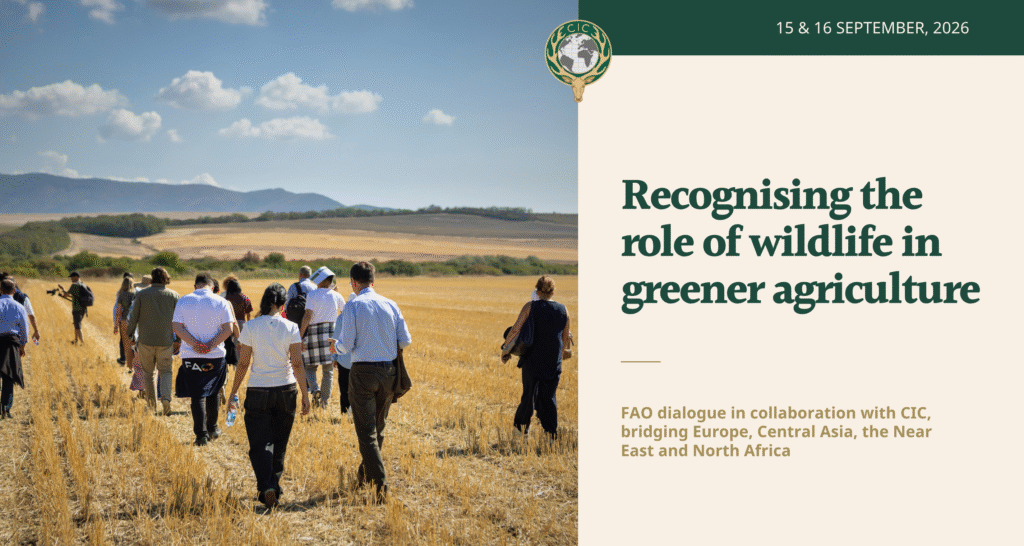
On the second day, participants travelled to Kozárd in northern Hungary, where CIC member Péter Pál Hajas, joined by Péter Tóth of BirdLife Hungary, guided the field study through a working agricultural landscape.
The visit offered a detailed look at how regenerative agricultural practices can improve soil condition and resilience while creating better habitat for farmland wildlife. Hajas’s approach is driven in large part by the needs of farmland biodiversity, with healthy soils, diverse vegetation, field margins, shelter, water availability and connected habitat all contributing to landscapes capable of supporting migratory birds, songbirds, small game and other species.
Participants saw how these elements reinforce one another. Soil management influences water retention and drought resilience, vegetation provides food and shelter, and abundant invertebrate life supports both soil health and the wider food web, including young birds. Rather than focusing on a single technique, the field visit demonstrated how regenerative practices, habitat management and productive agriculture can work together at landscape level.
Wildlife as part of the food system
CIC Programme Coordinator Thomas Paulic presented game meat as an often overlooked part of a resilient food system. He focused on what happens between sustainable harvest and the consumer, including the role of inspection, processing and shorter local supply chains in making wild meat more accessible while retaining value in rural areas. Using European data from the Wild Harvest Initiative®, he noted that around 276,000 tonnes of wild meat are harvested annually in Europe, equivalent to roughly 1.6 billion meals.
Participants then shared a lunch featuring locally supplied wild game before continuing the policy dialogue in Kozárd.
The countries represented at the dialogue came with very different agricultural systems, ecological conditions and policy contexts. There is no single model that can simply be transferred from one landscape to another. But the discussions in Budapest and the experience in Kozárd pointed towards a common principle: agricultural landscapes can remain productive while supporting healthy soils, functioning ecosystems and viable wildlife populations.
Where those conditions come together, wildlife conservation, sustainable use, food production and rural livelihoods can form part of the same resilient agrifood system.
https://cic-wildlife.org/peer-reviewed-research-confirms-the-food-value-of-wild-harvest/